
Van Buren Previous Residents Sources
Van Buren house history works best when the source matches the era. Current Van Buren assessment starts the place identity. Deeds follow owners. Address-first directories and census schedules add occupants. Maps test whether the same structure or street context existed. Newspapers, probate, and court records may then explain a departure, death, inheritance, or name change.
| Source | Years it covers | Where held | What it shows |
|---|---|---|---|
| Online recorder index | Exact first year not disclosed | Crawford recorder portal | Grantor, grantee, instrument, image access |
| Deed index and books | Index 1877-1920; deeds cataloged 1877-1887 | FamilySearch and clerk | Owners and legal descriptions |
| Criss-cross directories | 1955; 1966-1996 | Library of Congress collection | Listed occupant by address |
| Federal census | Public schedules through 1950 | Library and archives databases | Household relationships and residence |
| Sanborn maps | 1886-1914 editions | Library of Congress | Street layout and structures |
| Permit and elevation files | Exact start not stated | Van Buren city counter | Work, applicant, lot, and block |
Start with the newest reliable identifier and move backward. For a twentieth-century Van Buren address, reverse directories may provide the quickest occupant clue. For earlier land, the deed index and legal description matter more. The previous residents trail must state gaps plainly rather than converting an unknown portal cutoff into a guessed date.
Anchor Van Buren Past Residents
Begin with today's Van Buren parcel in the Crawford County assessment system. Record the owner, situs address, parcel ID, legal description, subdivision, lot or block, and the source date. If the county card displays a mailing destination or homestead clue, keep it separate from the physical address. A different mailing address may indicate an entity, another property, or a nonoccupying owner. It does not identify nonowner occupants.
Then locate the Van Buren parcel on a map. The polygon should agree with the street point and legal description. Multiunit sites and larger metes-and-bounds tracts can make a simple street match unsafe. County values, improvements, and year-built fields describe property, not when a person moved in. The present parcel is an anchor for previous residents, not the answer by itself.
Note: Preserve the assessor's publication date because a current tax roll can lag a newly recorded deed or a recent address correction.
Trace Crawford County Owners Backward
The Crawford County Circuit Clerk/Recorder at 317 Main Street is the land-record custodian. Use the current Van Buren owner as grantee, meaning the party that received an interest. Match the acquisition record to the parcel's legal description. The seller is the grantor. Search that seller as an earlier grantee, confirm the same Van Buren land description, and repeat. A trust, estate, or corporate instrument may interrupt a simple sale pattern, so follow the party role shown in the document.
- Copy today's Van Buren owner, parcel ID, and legal description from the assessment record.
- Find that owner as grantee in the recorded-land index and note the recording date, instrument or book and page, grantor, and image status.
- Search the grantor as an earlier grantee. Reject same-name hits whose legal description points to different land.
- Repeat until the online index ends, then ask the recorder about gaps, office terminals, and older grantor-grantee books.
- Carry each index citation into its deed volume. Do not treat the index entry as a substitute for the recorded instrument.
- Grantor and grantee
- The grantor gives or conveys an interest; the grantee receives it.
- Chain of title
- The linked series of recorded transfers for the same land.
- Legal description
- The lot, block, subdivision, or metes-and-bounds language that identifies land apart from its street number.
- Recording date
- The date an instrument entered the public record. It may be later than its signing date.
The Crawford Circuit Clerk site explains office access and record custody.
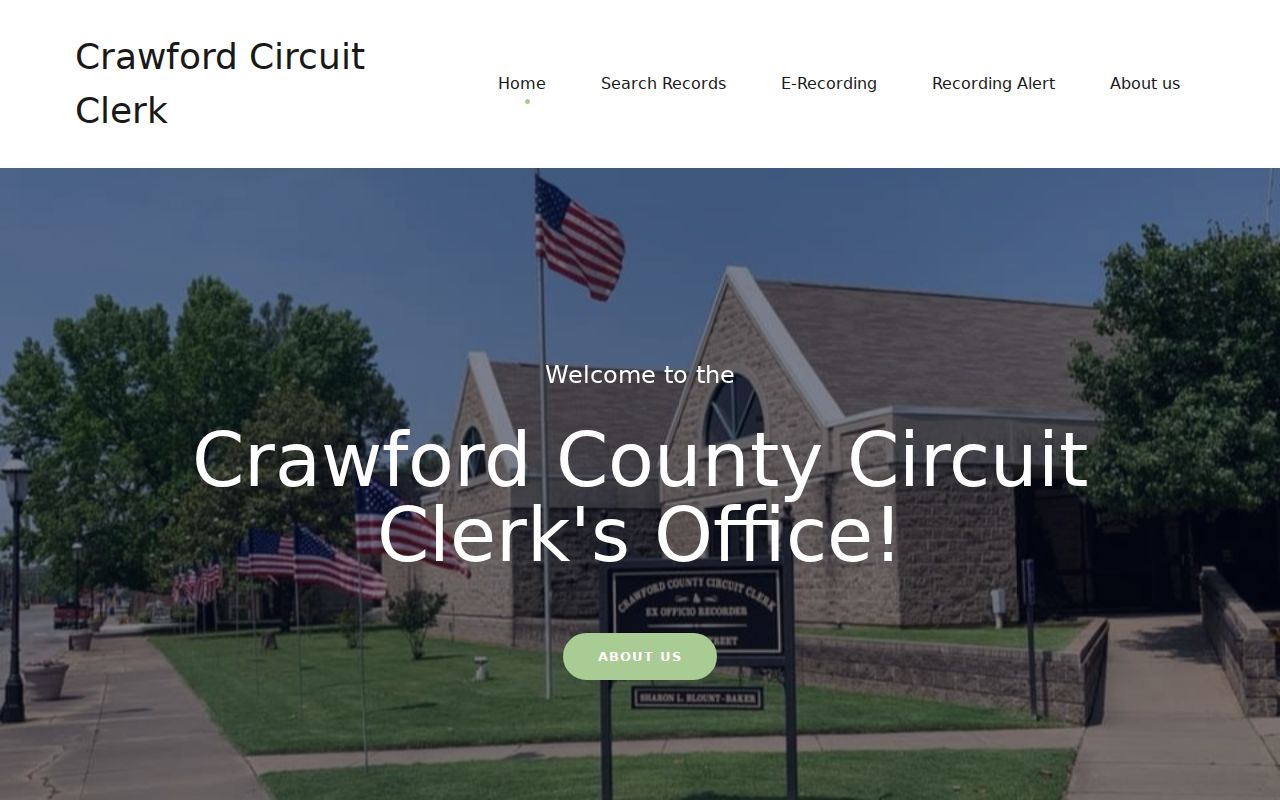
The office page is the fallback when an online trail ends or a certified copy is needed.
Open Van Buren Deed Records
The Crawford land-record index is account gated. Its public-facing material does not disclose the earliest online year or expose a verified field inventory. Avoid claims that every Van Buren deed is online. The recorder counter remains the source for coverage questions, older books, and official originals.
Review the recorded-land entrance before using the captured login view.
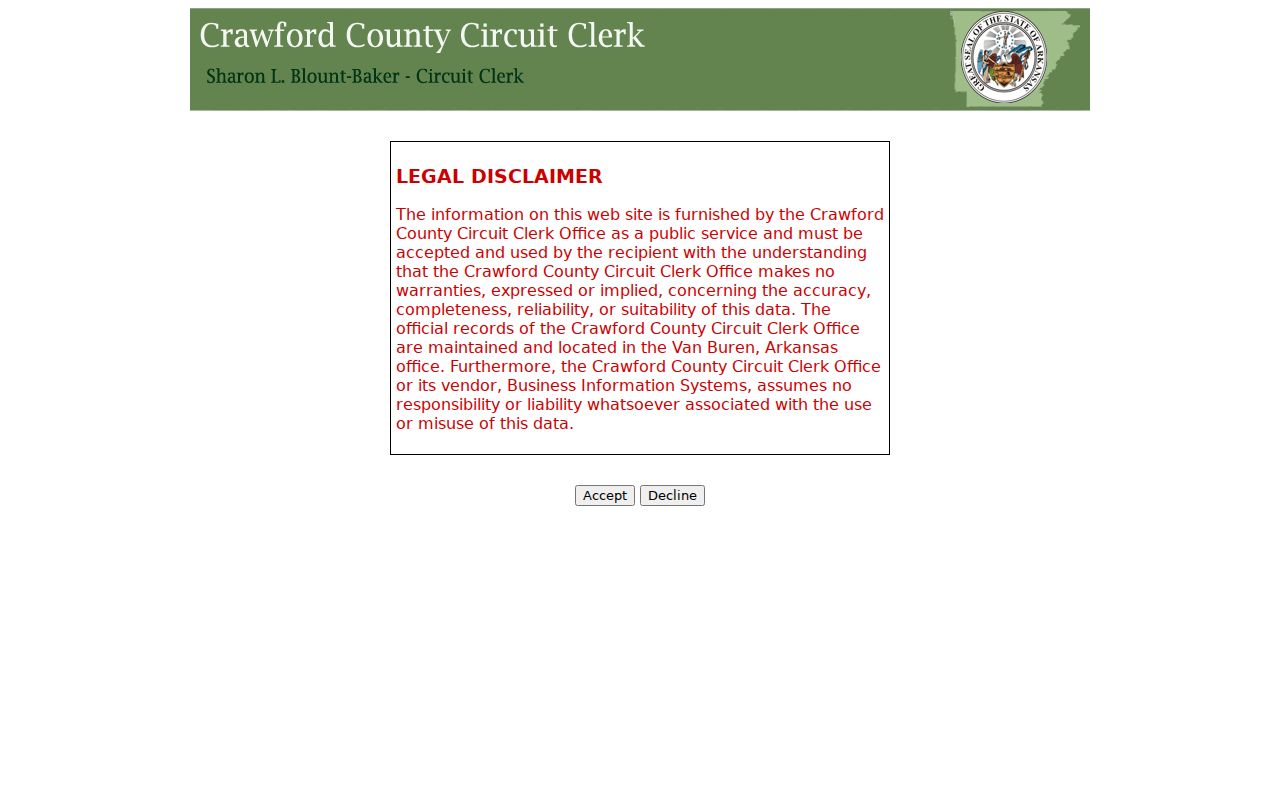
The capture shows why an account-free sample record and exact cutoff could not be verified.
Noncommercial TitleSearcher access requires a $5 starting deposit, then charges $0.25 per opened name and $2 per document image. At least $5 must be added within 24 months or the balance and account are lost. Visit the source before viewing its captured access terms.
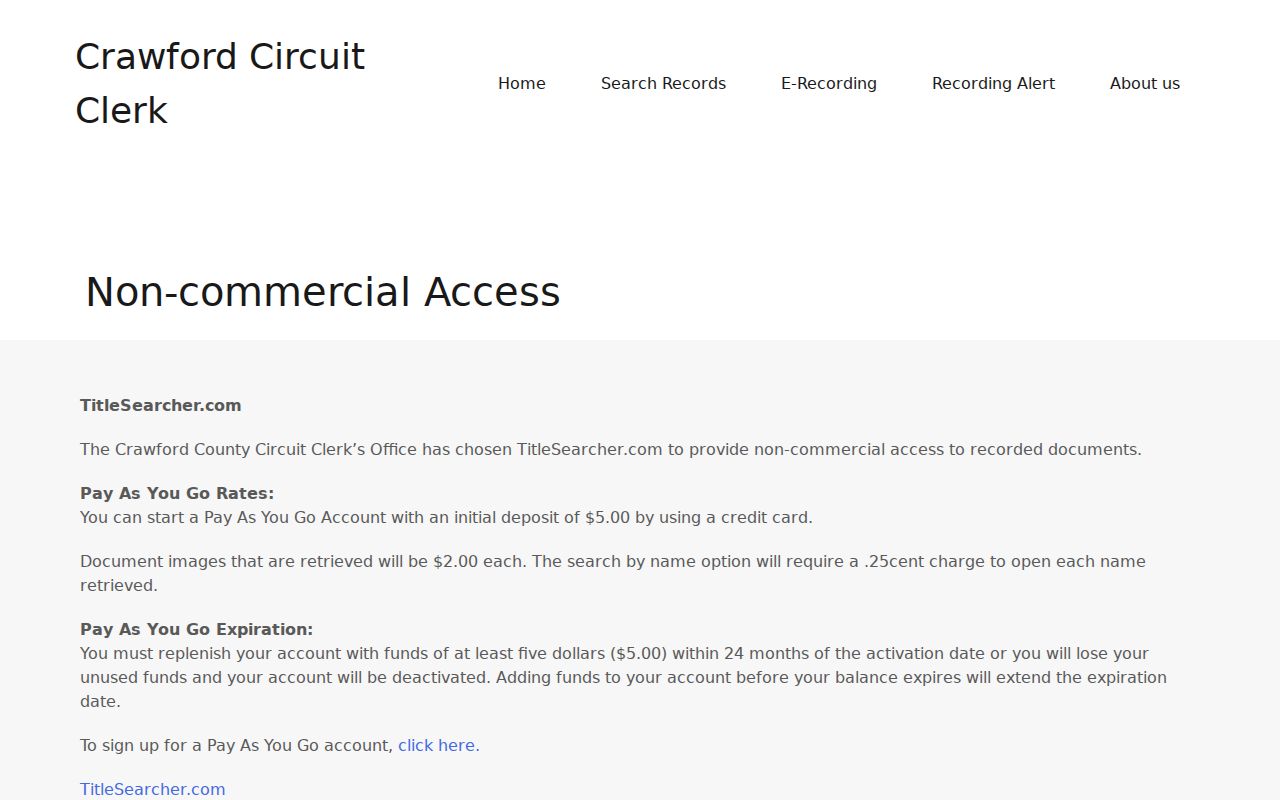
These terms make a focused owner-by-owner search more practical than opening every similar name.
Van Buren Residents Since 1877
The FamilySearch Crawford deed catalog is the key Van Buren pre-online bridge. Its title covers deed records from 1877 through 1887 and an index to deeds from 1877 through 1920, filmed from courthouse originals in 1978 on nine reels. Index volumes overlap: A-B spans 1877-1889, C-E spans 1889-1905, E-H spans 1899-1915, and H-J spans 1913-1920. Overlap can catch a spelling or carryover, but it also means checking the correct volume.
Open the Crawford deed catalog before viewing the captured collection record.
The catalog supplies verified years for the historical fallback without implying that all images are open from home.
Digital images may require sign-in or a FamilySearch Center because access contracts can change. Copy the index citation first, then move to the matching deed book. Previous residents research should distinguish that cataloged range from the undisclosed online recorder range.
Match Van Buren Past Residents
Van Buren owners are only one part of the address story. Fort Smith, Van Buren, and Barling criss-cross directories cover 1955 and 1966 through 1996 in the Library of Congress address-directory collection. These volumes start with a street address and may supply a listed occupant. Confirm the Van Buren section because the title spans several cities, and cite the year because directory publication can lag a move.
Pair the Van Buren address directory with the nearest released federal census year. Public census schedules run through 1950 and can show household relationships and residence. The process is simple: locate the address or household in the directory, check name variants and nearby street numbers, find the census household, then compare it with deeds and newspapers. Never merge an owner list, a directory listing, and a census household as though they describe the same population.
Obituaries and probate can close a trail. The digitized Van Buren Press covers 1859 through 1914 with a Civil War suspension, while scattered Van Buren Argus holdings add later local evidence. Search an occupant's full name, initials, relatives, and the street. A legal notice can link a name to land; an obituary may identify kin or a former place. The historical directory collections themselves are detailed on the Van Buren city directory page.
Lawful use. Trace previous residents for house history, genealogy, heirs, and personal curiosity. Never use historical or current address clues to track, harass, threaten, or harm a living person.
Map Van Buren Resident Addresses
Sanborn fire-insurance maps exist for Van Buren in 1886, 1892, 1897, 1904, 1909, and 1914. Their sheet counts grow from two to twelve across those editions. That measures mapped urban expansion, not population. The maps can show footprints, construction and use symbols, streets, and outbuildings. They cannot supply resident names, so pair each place with a directory, census, newspaper, or deed.
No authoritative Van Buren renumbering date was found. Do not assume that an old and modern street number refer to the same structure. Compare street names, lot shapes, subdivision plats, the legal description, annexation files, and map footprints. Legal description is the strongest bridge because a postal label may change while the land identity remains.
Van Buren permit and elevation files add more context. Van Buren's building records can identify an applicant and property work; flood files can be searched by address, lot, or block and may include an elevation certificate. Neither establishes who moved into the finished structure. They date work, not occupancy.
Note: A postal address using Van Buren may fall outside city limits, so check planning jurisdiction before choosing the city or county custodian.
Van Buren's Lost Record Years
Union forces captured Van Buren in December 1862 and destroyed courthouse records and a newspaper office. The event explains why a backward deed trail may fail before the postwar books, but it does not justify saying every early record vanished. Test survival record by record. A reconstructed deed, tax reference, newspaper item, military source, church register, or later legal notice may preserve part of the chain.
The 1877 start in the FamilySearch deed and court catalogs makes the Van Buren reconstruction boundary visible. When a title chain stops there, switch evidence types. The 1888-1889 Polk gazetteer can identify named workers, firms, and officials near the missing 1890 census, though its inspected entries do not provide verified home addresses. Early Sanborn sheets give place context. Census, probate, and local newspapers connect people.
This local record-loss story changes method, not standards. A gap remains a gap until another source bridges it. Mark inferences and preserve full citations so later researchers can distinguish a documented previous resident from a plausible same-name person.
Extend Van Buren Resident Trails
Van Buren court and naturalization books can add a named event after an owner or occupant is identified. FamilySearch catalogs Crawford Circuit Court volume A for 1877-1880 and an index for 1877-1905. Its naturalization catalog includes declarations from 1896 through 1910 plus a 1909 certificate. These sources do not replace deeds or directories. They supply party, case, immigration, and date clues that may distinguish two people with the same name.
Review the Crawford Circuit Court catalog before viewing its captured record.
The catalog gives verified coverage for a supporting legal trail without claiming that a party lived at the subject address.
Then inspect the Crawford naturalization catalog and its captured collection page.
Naturalization evidence can sharpen identity and chronology, but an address link still needs an independent deed, census, directory, or newspaper match.
Verify Van Buren Previous Residents
The Van Buren Library Genealogy Room at 1409 Main Street holds source books, digital archives, DVDs, microfilm, and research databases. Its microfilm reader and library-only Ancestry Library Edition support census and directory work. HeritageQuest is available from home with a library card. The branch is open Monday, Wednesday, and Friday from 8:30 a.m. to 5 p.m.; Tuesday and Thursday to 6 p.m.; and Saturday from 10 a.m. to 2 p.m.
At the courthouse, ask the recorder for the actual online start, gaps, office-terminal coverage, and the book needed from an index citation. Official originals remain with the office. The counter also avoids guessing when a name is missing behind the account gate. If a city permit, flood, annexation, or planning record is not posted, request the existing file by the precise address, parcel ID, and legal description.
End with a Van Buren source ledger. For every proposed previous resident, record the name as printed, address form, source title, year or date, page or image, and the link to the parcel. Mark whether the evidence proves ownership, listed occupancy, a household relationship, or only a nearby event. That distinction keeps the backward trail useful even when Van Buren records are incomplete.